


The Quiet Coup: How an Advertising Blueprint Buried Marketing
“I think that ill-feeling has held my businesses back. And so, with nothing to lose but nausea, I started breaking the rules” - Jo Starling
The Quiet Coup: How an Advertising Blueprint Buried Marketing
WTF happened to all the Ps in marketing?
Somewhere between Product, Price, Place and Promotion, we lost the plot entirely and ended up living in a world of Fs instead: Frenetic Founder Funnel FOMO. And the maddening part isn’t that founders are doing it — it’s that it demonstrably isn’t working, everyone can see it isn’t working, and they keep doing it anyway. Scroll any feed and the evidence is stacked to the ceiling: desperate dross, spat out by whatever AI “creative” prompt is trending this week, shared earnestly and proudly in a follow-for-follow group — ironically, probably by a competitor running the exact same prompt — and ravenously adopted by all. Everyone’s funnel looks the same. Everyone’s copy sounds the same. And still, founders keep reaching up and putting that crap-filled funnel on their heads like it’s a crown!
I hate to be the bearer of bad tidings, but it’s a marketing dunce cap.
I wanted to know why this is our modern reality. These are smart, capable, contribution-inspired people. So what actually happened — historically, structurally — that made the funnel feel like the only hat in the shop.
Turns out, it’s a hundred-and-twenty-eight-year-old story. And it only really goes wrong in the last twenty.
The Ps you were promised, and the one you actually got
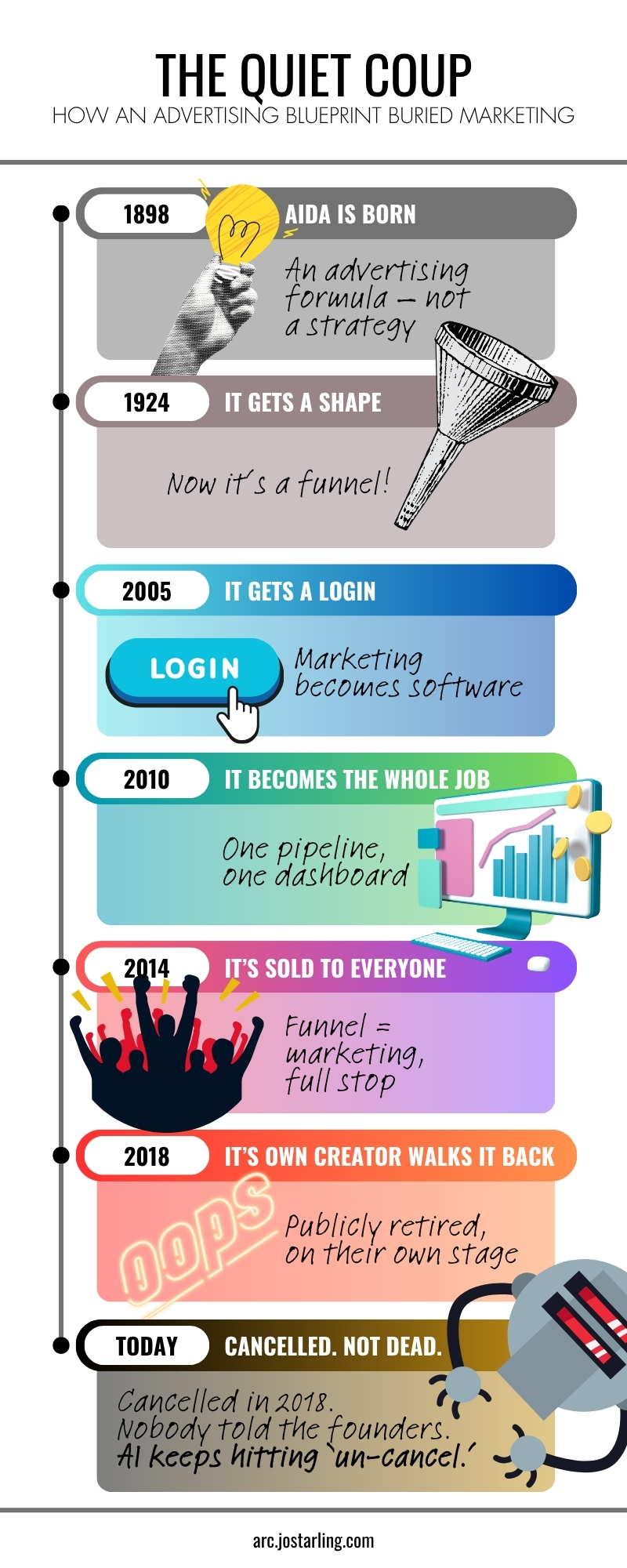
Marketing, properly defined, is enormous. It’s product, pricing, distribution, positioning, relationships, retention, referral — the entire system of creating and exchanging value with another human being. Advertising is one sliver of that: paid, one-way, non-personal promotion. And the funnel — the thing nearly every founder has been handed as “how you do marketing” — isn’t even all of advertising. It’s one specific formula, from 1898, for how a single print ad should work: get attention, hold interest, create desire, prompt action. It didn’t even get its funnel shape until 1924, when William Townsend drew a narrowing cone around someone else’s stages — a full generation after the words existed, before the picture ever did. A copywriting method, quietly dressed up over the decades as an entire strategy.
I’ve told the fuller, stranger story of just how old that formula actually is elsewhere — it predates powered flight, if you can believe it. Here, I want to answer a different question: not when it was born, but when it staged the takeover. Because that part isn’t one moment. It’s two, twenty years apart, and neither one was a conspiracy.
Here’s a quick fly-over... we’re going to pick this story up in 2005.
2005: the funnel gets a login
HubSpot launches, and builds its entire inbound methodology — attract, convert, close, delight — directly on top of the old funnel shape. Clever. For the first time, “funnel” stops meaning “how one press ad performs” and starts meaning “the system my marketing runs on.” Software does something language alone never could: it makes an idea feel like infrastructure. Once a thing has a login, a dashboard, and a monthly subscription, it stops feeling like a theory you can question and starts feeling like a fact you build around.
2010: the funnel becomes the whole job description
“Growth hacking” takes hold, and Dave McClure’s AARRR framework hands the funnel to founders as the entire strategy for their business — acquisition, activation, retention, referral, revenue, one pipeline, one dashboard. Around the same time, Facebook’s ad platform matures enough that we founders can genuinely run something that feels like a whole business through a single paid channel. Social media usually gets the blame for all of this, and that’s not entirely wrong, just a touch premature — it wasn’t the cause. It was the moment the funnel finally got a machine efficient enough to run entirely on its own.
2014: the funnel gets sold to everyone
This is the one I’d point to if you forced me to pick a single date. Russell Brunson and Todd Dickerson launch ClickFunnels, and within three years it’s a hundred-million-dollar company teaching hundreds of thousands of small business owners that “funnel” is marketing, full stop. His own books say the quiet part out loud in their titles — one promises to help you build “a mass movement of people who will pay for your advice”. Movement. Loyalty. Community. That’s territory the 1898 formula was never built to hold, folded into “funnel” language and sold, at scale, to people who’d never heard of the four Ps, let alone which one advertising actually lives inside of. This is the moment the drift stopped being an accident and became an industry.
2018: even the company that started it walks it back
HubSpot — the same company that helped digitise the funnel into software in 2005 — stood on stage at their own conference and publicly retired it. Their CEO’s own words: the funnel treats a customer “as an output... rather than a very valued input”, and it was never built to account for referral or word of mouth, because it simply wasn’t designed to. That’s not me saying the funnel got misused. That’s the company that originally turned it into marketing infrastructure, admitting it, out loud, on their own stage, thirteen years after they’d launched it to the mass market.
“The funnel treats a customer “as an output... rather than a very valued input”, — That’s the ICK, right there!
No conspiracy. No villain. Just overreach, twice, by people with something to launch
Here’s the thing I actually want you to sit with: nobody set out to bury marketing. E. St. Elmo Lewis never claimed to have invented the whole discipline — he was describing how to write a decent ad. HubSpot built genuinely useful software. Brunson built a genuinely useful tool for a genuine problem he’d personally lived. Nobody plotted this in a room together. It happened the way most quiet coups happen — not through a single seizure, but through twenty years of good-faith overreach, each version a little more totalising than the last, until an entire generation of founders inherited a belief system instead of a discipline, and never knew there was a difference.
Which is exactly why it’s still happening now, louder than ever. AI didn’t create funnel-thinking — it just removed the last bit of friction standing between a founder and another identical funnel. Same four stages. Same manufactured urgency. Same hollow “creative” prompt, run by a hundred different businesses in the same week, shared without irony in the very groups meant to help founders stand out. The tool got faster. The belief underneath it never got questioned.
And I owe you the same honesty I’ve just given HubSpot and Brunson: I’m not writing any of this from outside it. I’m a founder with something to launch too. It would be easy to tell this story as though I’d spotted the flaw in the funnel early and simply declined to use it, while everyone else queued up to inherit it. That’s not what happened. I built on it for years, the same meat grinder as everyone else, believing it was the accepted “right way”.
But like most of the founders I work with, it never sat well with me. And I think that ill-feeling has held my businesses back. And so, with nothing to lose but nausea, I started breaking the rules.
A wise man once told me hindsight is 20/20 vision. He was right, and it’s the actual reason any of this is visible to me at all — not because I saw further than the people who came before me, but because I’ve lived on the wrong end of what a funnel does to a relationship, same as you probably have, and you can’t un-feel that once you have. Founders cry out for a better way constantly. I’m one of the loudest. When HubSpot’s own CEO admitted the funnel treats a person as an output rather than a valued input, I didn’t read it as a corporate mea culpa. I read it as someone finally saying out loud the thing that had been quietly forcing good, well-meaning founders to mistreat their own customers for twenty years running.
Nothing about true marketing died in any of this. It’s all still there and it is all still true. It still rewards whoever’s willing to look past the ravenous P that cannibalised the other three in the public imagination. Marketing didn’t get killed. It got buried, quietly, under two decades of software launches and sales pitches, by people who mostly believed their own hype and that they were doing the business world a service. I believed that myself, longer than I’d like to admit.
Buried things can be dug back up. It doesn’t take heavy machinery, either — usually just someone stubborn enough to keep at it. It’s taken me a lot of nauseating years to reach for the shovel, but piece by piece, I’ve swapped out my derelict funnel for the INTERACT Arc™. Not a better funnel. A different shape of exchange entirely.
© Jo Starling 2026. All Rights Reserved. Please feel free to quote my articles, but please give credit accordingly and include a link back to this site (www.arc.jostarling.com). All images are protected. Please contact Jo Starling for conditions for publishing by requesting use through my contact page.